
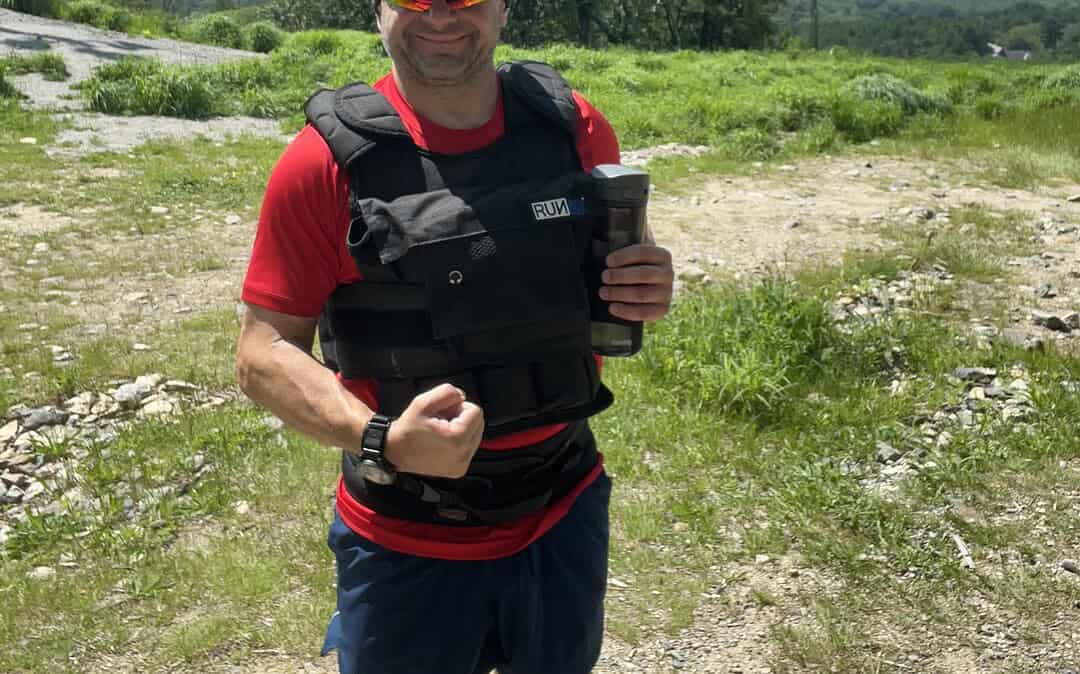
For years, I lived next to one of the most valuable obstacle course racing (OCR) training grounds in the region and didn’t know it. That changed more than five years ago when I began my OCR journey — a sport I quickly grew to love.
That training ground is the Blue Hills Reservation — 7,000 acres of rugged terrain, winding trails, and steep climbs right here in our backyard. As an OCR athlete, primarily racing Spartan events, I’m fortunate to train in the Blue Hills almost daily. The varied landscape challenges my endurance, strength, and grit, helping me prepare for some of the toughest races in the sport.
Let’s first talk about what OCR is. The initials stand for obstacle course racing, which is fairly self-explanatory. However, there are many OCR brands, types of races, and communities dedicated to the sport, with Spartan the largest brand of all. Think U.S. Army bootcamp-style training with monkey bars, rope climbs, walls and hurdles, and lots of heavy stuff to carry. In a typical Spartan race, there will be sandbag carries; rolling mud pits; bucket carries, 4- to 8-foot walls to climb over, plus the most failed obstacle, the spear throw, and lots of running. Lots and lots of running.
That’s where the Blue Hills come into the picture for me.
There are more than 125 miles of trails and and collectively thousands of feet of elevation. That includes a ski slope with about 300 feet of vertical elevation gain (or many times that with repeated climbs). So, I can’t think of a better place to find the two most important training components for a Spartan race: distance and elevation.
Going the Distance in the Blue Hills
There’s a saying in the Spartan community that to be able to take on the longer races (anywhere from 21-50 kilometers, or 13-30 miles), you have to have time on your feet. Well, running in the Blue Hills can give you hours upon hours of time on your feet. For example, the White Triangle trail, which follows Bugbee Path, Forest Path, Dark Hollow Path, Tucker Hill Path and others, is about 9 kilometers total (about 5.6 miles). Do a loop around Houghton’s Pond, and that’s 11 kilometers (about 6.8 miles) total. Go on to ascend Buck Hill, North Boyce Hill, and Tucker Hill to add not only another 5 kilometers (about 3 miles) in distance but also close in on 1,500 feet of elevation.
That’s some good time on the feet.
Adding in Elevation
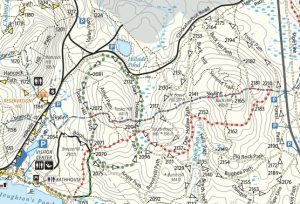
If you want both distance and elevation, head to the western side of the park and take a trip on “Mr. Toad’s Wild Ride” by following the yellow triangles on Breakneck Ledge Loop!
Here’s where you start with a solid ascent (about 100 feet or so) as you work your way from the trailhead at Reservation Headquarters and the State Police barracks deep into the park. The trail borders the periphery of the park and the town of Milton along Breakneck Ledge Path, Chestnut Hill Run Path, Border Path, and Puddle Path. Then you take a hard right onto the Skyline Trail North and go straight up more than 500 feet to Elliot Tower.
This is a great place to take a breather because it gets a lot harder from here!
Go down Coon Hollow Path only to go back up the other side of the path (informally known as Abigail Adams Path), and you’re back to Eliot Tower again. Hang another right and head on over to the top of the William F. Rogers ski slope (the Blue Hills Ski Area).
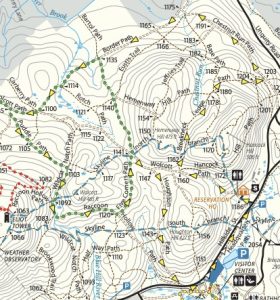
You can gain another 600 feet of elevation as you go down and then back up the black diamond slope Big Blue a couple times, with your final descent shifting over to the intermediate ski trail Patriot to the easiest ski slope called Sonya, wrapping up your ski area repeats at the ski lodge. From there you go under the ski lift onto Accord Path, which is open only when skiing is not.
This path crosses the Skyline Trail that will take you back up to Elliot Circle and the tower. It’s a tough ascent, but you then head down the Skyline North trail and back on the Breakneck Ledge Loop until it spills out onto Hillside Street, which you have to cross to get to the home stretch of your 10-miler and 2,500 feet of elevation: a loop or two around Houghton’s Pond! That’s definitely 4.5 to 5.5 hours depending on how hot it is.
Nick’s Training Tips
Hydration: If you’re going to take on this kind of training, I highly recommend wearing the biggest hydration pack you can find (I have a 3-liter CamelBak). This is an endurance trail run that is bespoke for tougher Spartan races, especially the mountainous ones like Vernon, Palmerton, and Killington (for example, 7,000+ feet of elevation gain for the Killington Beast, and 14,000+ feet for the Ultra).
Weighted vest. On a day that I’m not running the trails and hills, I go directly to the Blue Hill Ski Area and put on my weighted vest, and simply hike up and down the Big Blue ski slope as many times as I can. It usually takes me about 4 to 6 weeks for me to work up to wearing the vest with its full 60 pounds, so don’t go all in on weight at first. But, it is a killer way to build those alpine hiker legs!
Trail shoes: Wear trail shoes with large lugs on the soles that can grip the ground (e.g., Innov-8 X-Talons with 8-mm lugs).
Trail map: Friends of the Blue Hills members get a free paper map when they join, so if you’re not already a member, join up today. Pulling out this map to orient yourself in the park is much faster and easier than managing your phone.
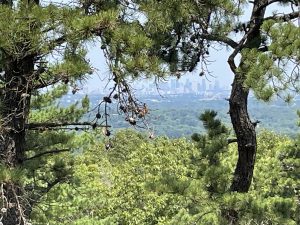
Oh, and the views from Elliot Tower and Buck Hill are amazing.
Personally, I feel like I’ve only scratched the surface of what is possible for training opportunities in the Blue Hills. I’m looking forward to extending my distance well into areas I haven’t even explored in the park, including the Quincy and Braintree sections and Ponkapoag Pond.
The Blue Hills offer so many things to do, from swimming and picnicking to hiking, horseback riding, fishing, nature watching, trail running, seasonal skiing, Spartan Race training, and so much more.
For me, I know I could never have survived and thrived in Spartan racing without the Blue Hills Reservation!